








 Xing
Xing  LinkedIn
 E-Mail
Decoding Future Consumer Identities
Introduction: Consumer Needs in Transition
Premium manufacturers, quality leaders, and technology leaders are under constant pressure to find new and unique sources of differentiation. Competitors quickly catch up with fading functional advantages, and consumers are becoming less loyal. This makes consumer foresight increasingly critical: to stay one step ahead in this tight competition, companies need a clear understanding of what consumers need and want next.
To uncover where new and lasting USPs, premium features and forms of leadership can emerge, it’s especially crucial to understand a specific type of needs: We call them signature needs.
By this, we mean identity-shaping needs that influence goals, behaviors, and decisions across contexts; emotional needs that consumers constantly think and talk about, which form the basis for (new) communities. Think of food enthusiasts organizing and gathering at fermentation festivals [1, 2] or people devoted to health and longevity tracking and optimizing almost every hour of their lives.
Such needs are rooted in broader trends and drivers, meaning that they remain relevant in the long term. They motivate consumers to continuously seek out better solutions across domains – because they become part of how people see themselves and how they aspire to live.
Signature needs are therefore strong and constant drivers for innovation; as well as for communication, community- and brand-building. At the same time, they are themselves evolving dynamically as cultural, technological, social, and economic conditions change.
Bold and transformative innovation that creates meaningful USPs and competitive advantages is built around these signature needs and the identities they create. It goes beyond the (incremental) improvement of familiar functional needs that have dominated product and service categories for years or even decades. The signature needs perspective helps companies uncover deeper consumer needs and access new levels of value creation. Signature need-driven innovation adds a deep emotional connection and identity-building power to quality or technological leadership.
It transforms products and services into enablers of self-realization.
As a result, they appeal precisely to the customer groups that have long been looking for better ways to fulfill a specific need. These groups are often both the most demanding and the most willing to pay. This is the intersection where premium value and differentiation emerge – and where the competition of the future will be decided.
At the same time, the trends and drivers behind many signature needs show that they have the potential to diffuse into the mainstream over time, at least in a “light” version, as current niche interests turn into hygiene factors. Let’s take modular and repairable products such as the Fairphone [3] as an example: They might mainly appeal to sustainability and tech enthusiasts today, but societal and regulatory trends as well as environmental pressures could turn this level of modularity, DIY-repairability and
DIY-customization into market access requirements and mainstream expectations.
Identity-driven innovation therefore allows companies to unlock new value creation early on and benefit from the momentum of engaged first-mover communities.
Every consumer goods company needs a clear view of the future needs landscape to make strategic innovation decisions.
What exactly are Signature Needs?
Signature needs are aspirational interests and needs that shape a person’s identity. They are closely linked to one’s ideal self-image and the pursuit of that ideal. This means that their pursuit is a long-term and, in a way, open-ended endeavor: not because they can never be fulfilled, but because people continue to cultivate them with ambition; constantly redefining, deepening, or expanding what fulfillment means.
The quest to fulfill a signature need often involves trade-offs in other areas of life, as people invest a disproportionate amount of time and/or money into it.
As a result, signature needs show up in different forms and intensities across different areas of life. They influence goals, behaviors, and decisions on an emotional level. In many cases, these shared needs and identities bring about communities, which develop their own cultural codes. People exchange ideas, learn from one another, and continuously look for better ways to authentically realize and express their identity across different parts of their lives.
Z_punkt has developed a first shortlist of future-relevant signature needs. This shortlist serves as a benchmark, based on our project experience and a driver analysis. It identifies signature needs that are robustly relevant across different areas of value creation and are therefore broadly relevant for consumer brands.
Depending on the industry and the specific strategic focus to which they are applied, these needs can be prioritized, enriched, detailed, and expanded in different ways to generate context-specific insight.
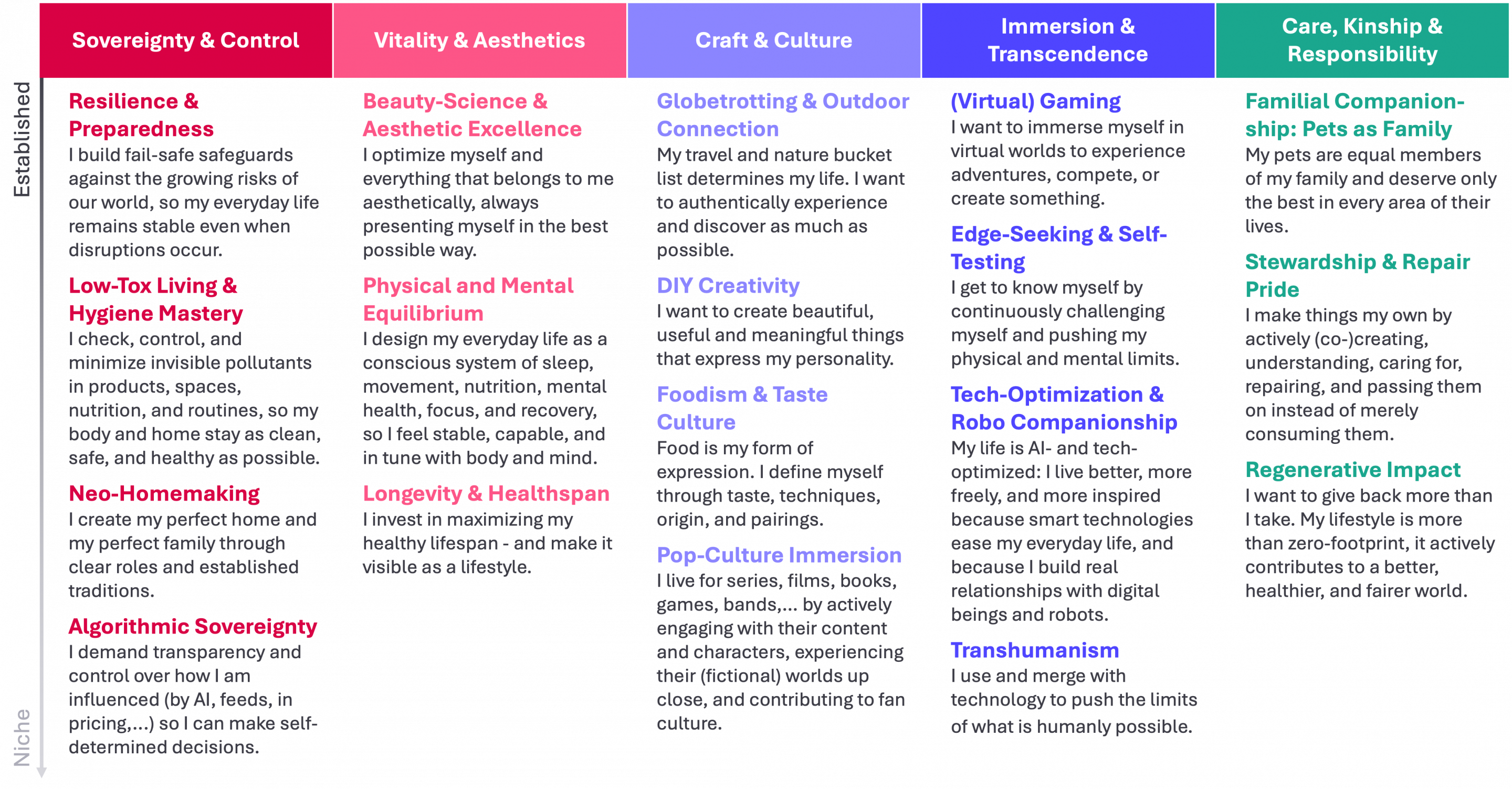
*Signature need shortlist based on Z_punkt project experience and driver analysis, sorted from established to niche within different categories
Why work with Signature Needs?
Signature needs help innovation teams to understand why certain needs become meaningful, valuable, and worth investing in. They look at future needs through the lens of identity and shift the focus from external dynamics to the inner logic of consumers: What will become meaningful to them? What priorities will they set? Which tensions will shape their decisions? Which trade-offs will they accept – and which will they reject?
This perspective is essential for consumer-centric and premium innovation. Signature needs reveal where concepts of quality are emerging, which expectations will become relevant for differentiation in the future, and how brands can build emotional, social, and cultural relevance beyond functional benefits. Compared with a stand-alone trend analysis, they offer a more precise view of value-based consumers with high strategic potential: Signature needs unlock new value propositions for the most demanding and willing-to-pay target groups.
Our signature need shortlist is made up of needs with this kind of future differentiation potential. It includes needs that are already broadly established today and will continue to gain relevance and/or evolve qualitatively over the 2030-2035 horizon. Other needs are still emerging but show strong growth potential and strategic relevance.
Signature needs either remain or become relevant over the long term. Enthusiasts often spend an above-average amount of time and/or money on indulging in a signature need.
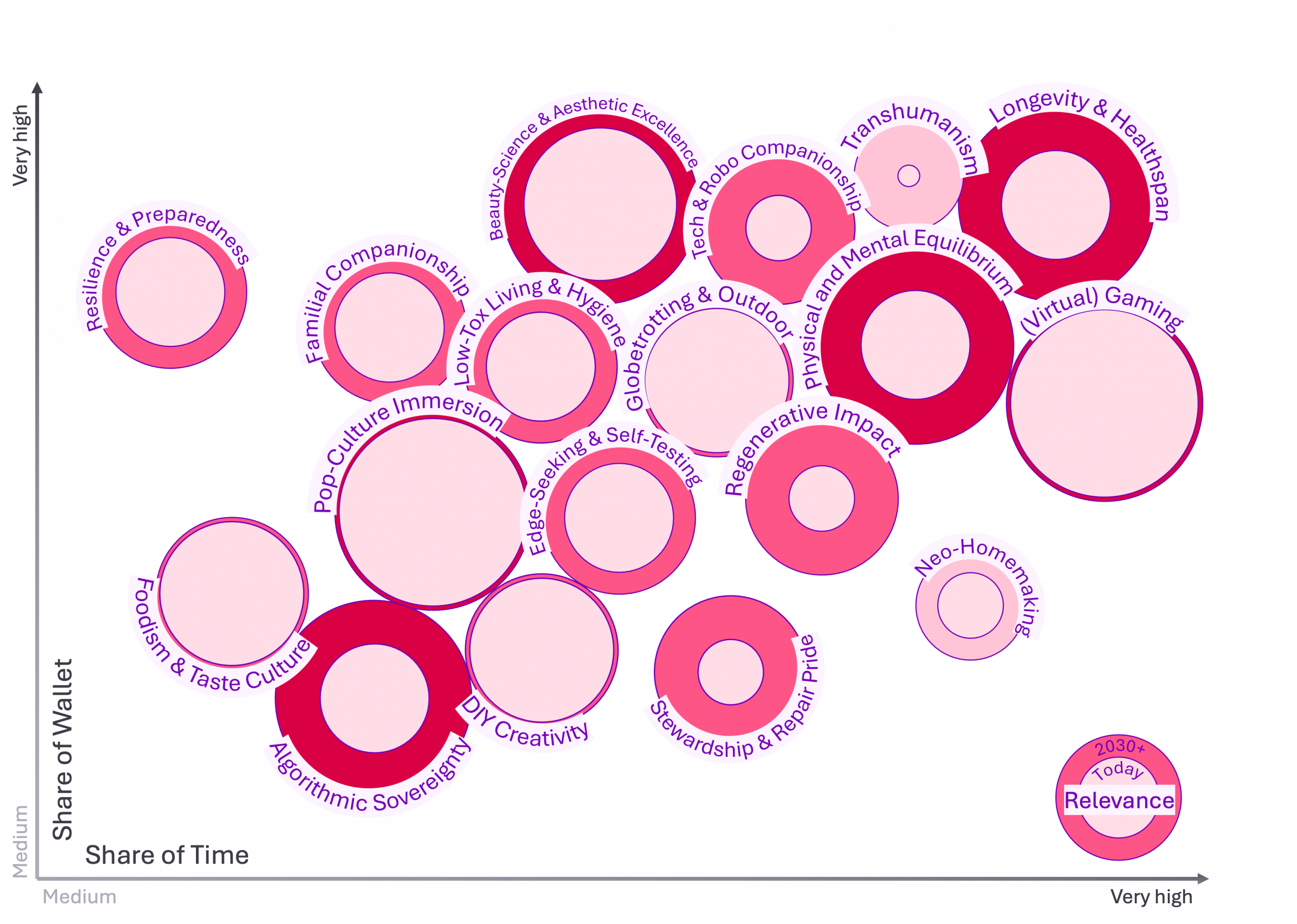
*Rough estimates of relevance today and in 2030+, as well as enthusiasts’ share of wallet and share of time; relative positioning.
Most signature needs affect one industry at its core (e.g., Longevity & Healthspan directly affects the health sector). At the same time, they show large and often disruptive potential to drive innovation across a variety of further industries, as consumers continuously look for ways to (better) realize and express their need-shaped identity across domains. This makes signature needs a powerful driver of innovation and new sources of differentiation.
Our heatmap, testing our signature need shortlist against the Z_punkt areas of value creation, visually illustrates how signature needs act as cross-industry search fields for innovation.
Integrating signature needs into strategic thinking early on helps companies to identify disruptions coming from outside of their own category sooner, build new capabilities and partnerships, and seize opportunities before they are occupied by new market entrants.
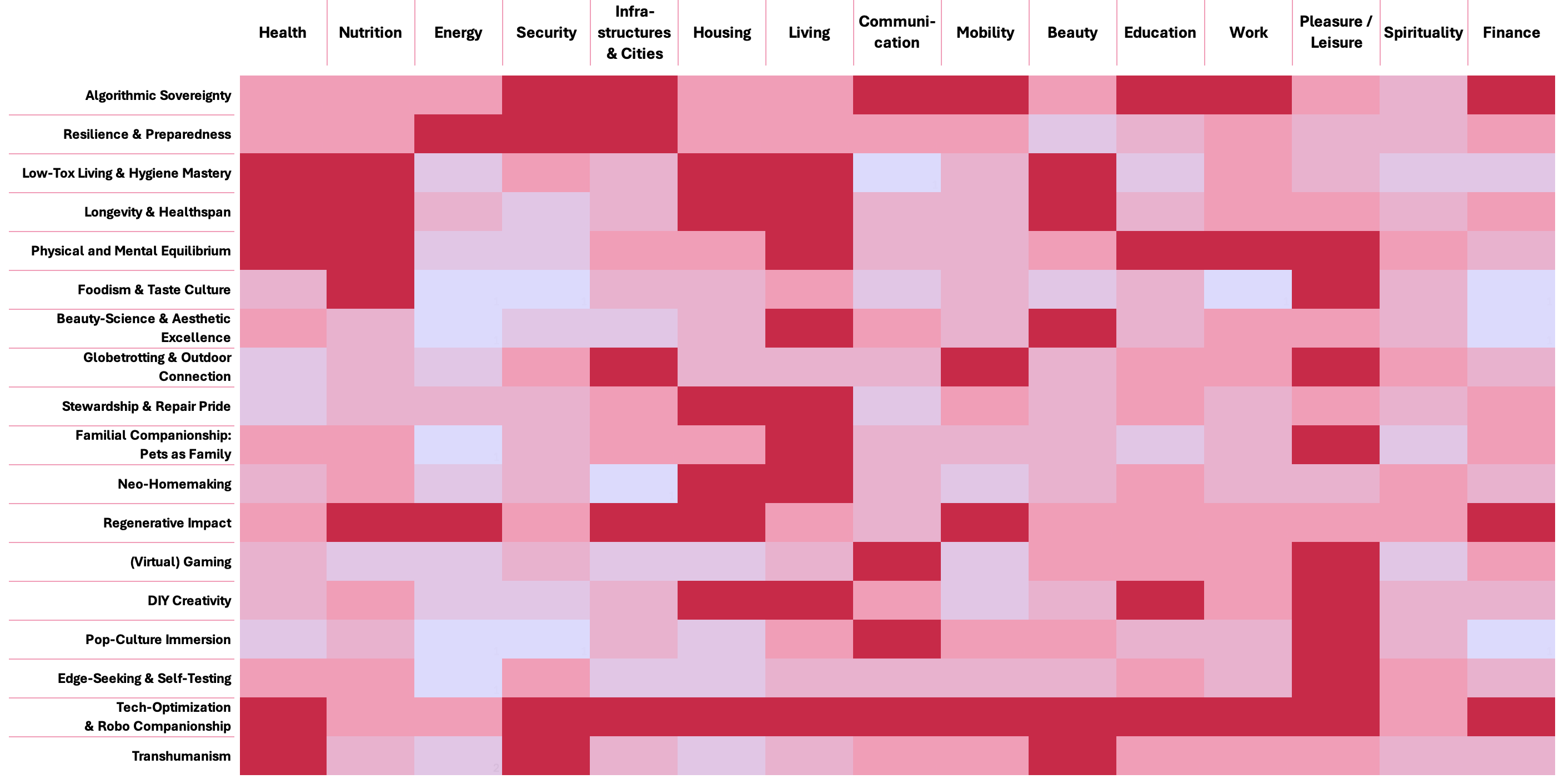
*Estimate of the future relevance of a signature need in the respective area of value creation based on its overall impact on value creation, including its potential for differentiation and disruption.
Signature needs redefine quality and tech leadership by aligning them with aspirational consumer identities. Premium positioning and brand status are increasingly dependent on addressing these identity-relevant needs in a superior way.
Companies that do so earlier and more credibly than their competition can define new marks of quality and set standards before they become baseline market expectations.
At the same time, signature needs provide access to particularly engaged consumers and communities. Brands that credibly address a signature need do not simply sell a product or service, they contribute to the realization of their customers’ self-conception. This allows them to lift value creation to a new level of emotional, social, and cultural meaning – and secure the loyalty of especially demanding consumers.
This makes signature needs an important strategic tool for consumer brands that want to protect themselves against disruption from outside their category and play at the forefront of consumer-centric innovation.
Signature Needs in Action: How Signature Needs Are Already Influencing Value Creation Today
Our heatmap shows that many signature needs do not remain confined to a single category. They become especially strategically relevant when they establish a new form of premium – or even leap into more distant areas of value creation, creating new quality concepts, standards and business models there. The following examples show how this logic is already becoming visible today.
Longevity & Healthspan: I invest in maximizing my healthy lifespan – and make it visible as a lifestyle.
MAVI brings longevity into architecture: a framework consisting of 10 longevity domains and 129 measurable factors translates longevity science into actionable architectural specifications. These are used to assess buildings and guide new builds and renovations to design spaces that actively support health and an extend healthspan [4].
Algorithmic Sovereignty: I demand transparency and control over how I am influenced (by AI, feeds, in pricing,...) so I can make self-determined decisions.
Kagi has created a new premium offering for privacy-first web search and AI use: to conduct more than 100 searches per month, users subscribe to plans of up to 25 USD/month. In return, Kagi offers ad- and tracking-free search experiences as well as access to various AI models [5].
Regenerative Impact: I want to give back more than I take. My lifestyle is more than zero-footprint, it actively contributes to a better, healthier, and fairer world.
Rebalance Earth uses pension funds as catalysts for nature-based solutions. Its fund treats nature as business-critical infrastructure and invests into nature preservation and restoration projects. Returns are generated by businesses dependent on ecosystem services and stability paying for this risk mitigation [7, 8].
Stewardship & Repair Pride: I make things my own by actively co-creating, understanding, caring for, repairing, and passing them on instead of merely consuming them.
Levi’s Wear Longer project is a free educational initiative teaching young people how to repair, alter and customize their clothing. Through multiple touchpoints from digital classes to workshops run in Levi’s stores, the brand supports its customers in realizing their ambitions of expanding their garments’ lifespan [9].
How do we use Signature Needs in Innovation Foresight?
Signature needs enrich innovation foresight processes with an identity perspective. They uncover opportunities for identity-driven, emotional value creation and differentiation. In practice, signature needs are always selected, explored, and prioritized in line with specific project requirements.
In a typical process, signature needs mainly come into play at two points:
- First, when scanning relevant developments, our shortlist serves as an input to test which signature needs matter in your chosen playing field: e.g., which signature needs might not yet have an obvious connection to an industry, but may exactly therefore hold the potential to shape meaningful differentiation and new standards early on?
- Second, when classifying and prioritizing future needs, we draw on the broader concept of signature needs and their defining characteristics. This allows us to identify additional developments with signature need potential - for example, needs that are more context-specific and therefore not part of our shortlist. We therefore assess future needs based on whether they…
- express an identity that consumers already hold or aspire,
- create passionately lived practices that shape goals, behaviors, and decisions across contexts,
- have talkability- and community-potential, creating social bonds, shared codes, and rituals,
- show high search intensity and innovation potential, because consumers continuously raise and refine their own expectations,
- have strong future and growth potential, because they remain relevant in the long term and can evolve through different drivers.
In an ideal-typical consumer foresight process, we run through six consecutive steps: In an outside-in process, we identify and define relevant signature needs for your industry and translate them into action-ready business tools, opportunities and strategic imperatives, guiding you towards your future positioning and new sources of differentiation.
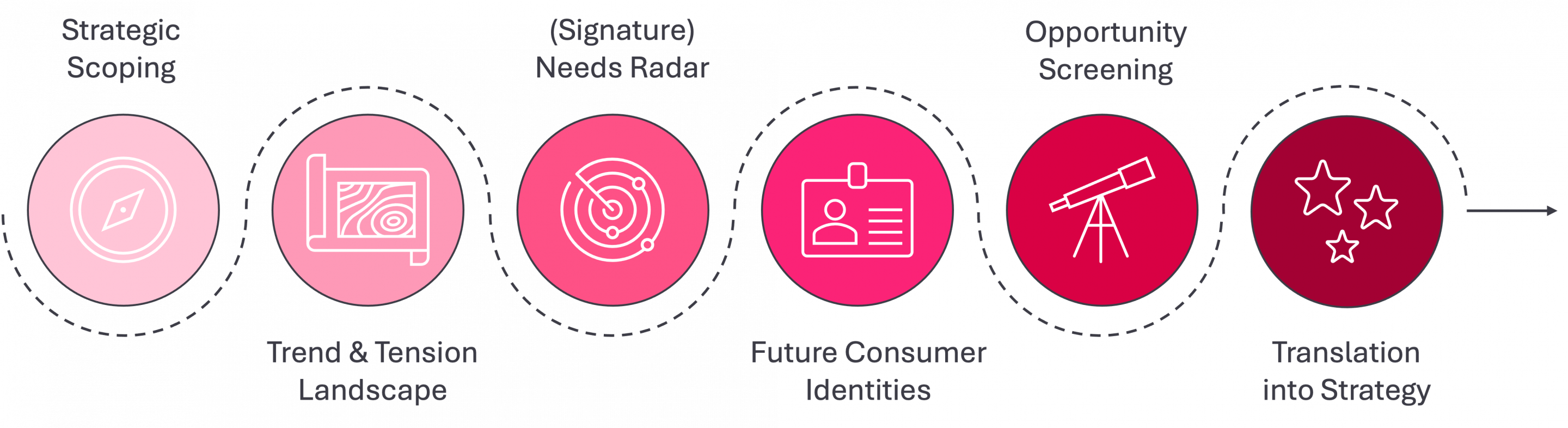
0. Strategic Scoping: Framing the project-specific search field, brand DNA, competences, ambition level and goals to ensure relevant rather than generic results
1. Trend & Tension Landscape: Mapping relevant (consumer) trends and tensions that shape consumers’ reality and decision making in the chosen playing field to contextualize future (signature) needs
2. (Signature) Needs Radar: Generating and prioritizing a project-specific list of future consumer needs, including signature need-hypotheses based on or aligned with the Z_punkt signature need shortlist
3. Future Consumer Identities: Translating future consumer needs incl. signature needs into concrete consumer identities, e.g. in the form of personas, and mapping context-specific consumer journeys to anchor insights into business-ready tools
4. Opportunity Screening: Identifying and detailing concrete opportunity areas that provide a clear direction and put a special focus on bold moves and transformative innovation rooted in signature needs
5. Translation into Strategy: Identifying meta-level enablers and capabilities needed to implement the opportunity areas, forming the basis of successful identity-driven innovation
We can develop individual processes and shorter workshop formats around signature needs and identity-driven innovation to meet specific requirements and goals, for example, to complement existing tools such as customer segmentation or personas.
Conclusion
Current forms of premium differentiation are under constant pressure. Signature needs can unlock a new form of differentiation rooted in consumer identities. We believe that such identity-driven innovation is the key to the next level of consumer-centric innovation, enabling the upkeep of premium positionings and the creation of new value propositions.
We use signature needs to understand the deeply aspirational needs of tomorrow’s consumers, which drive demand and disruptions across categories – and can shape innovation that creates emotional bonds, loyalty and cultural relevance beyond functional benefits.
For consumer brands, the strategic task is therefore not only to respond to changing needs, but to understand which needs are becoming identity-defining - and how these can be credibly translated into products, services, experiences, ecosystems, and capabilities. Brands that identify and address signature needs early on can set new quality standards, open up new spaces for value creation, and build strong relationships with the consumers and communities that will shape future markets.
Signature needs are not a replacement for existing innovation tools, but a powerful lens to enrich them. They help companies move from observing trends to understanding the identities they shape – and step up from incremental improvement to transformative innovation.
